Unified Messaging API for SMS, WhatsApp & RCS
Write Once. Deliver Everywhere with One Omnichannel Messaging API
One API for SMS, WhatsApp Business API, and RCS. Route across channels, fall back automatically, and reach customers in 100+ countries.
One API for SMS, WhatsApp Business API, and RCS. Route across channels, fall back automatically, and reach customers in 100+ countries.
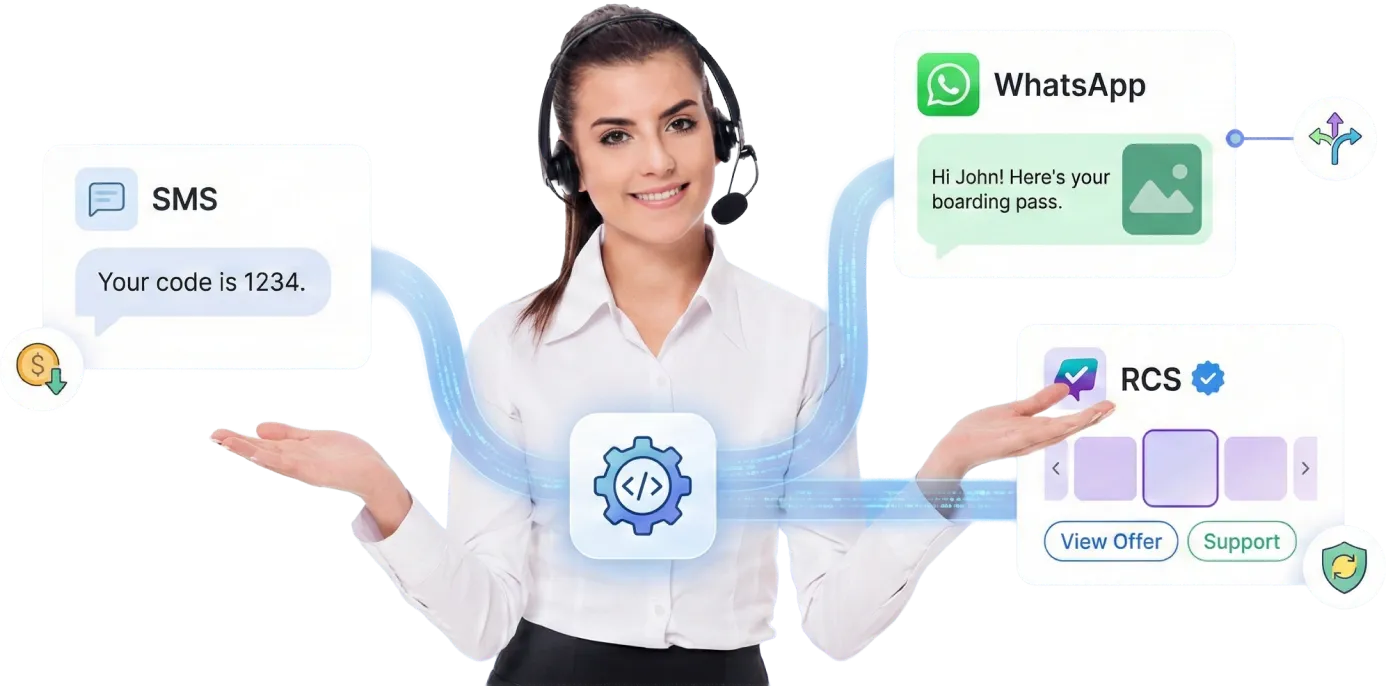
Replace multiple channelspecific integrations with one omnichannel messaging layer. Send messages via a single endpoint,
use a unified webhook for all delivery events, and let the smart delivery engine pick the best channel based on cost,
performance and historical delivery data.
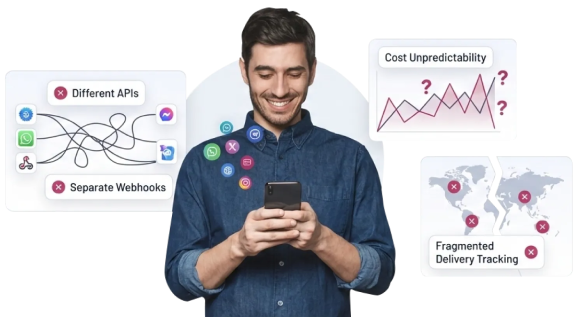
Different APIs per channel
Different payload formats
Separate webhooks
Manual fallback logic
Cost unpredictability
Fragmented delivery tracking
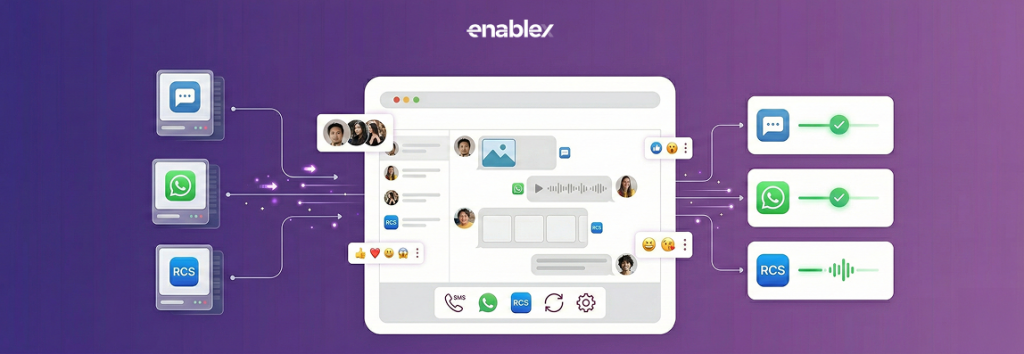
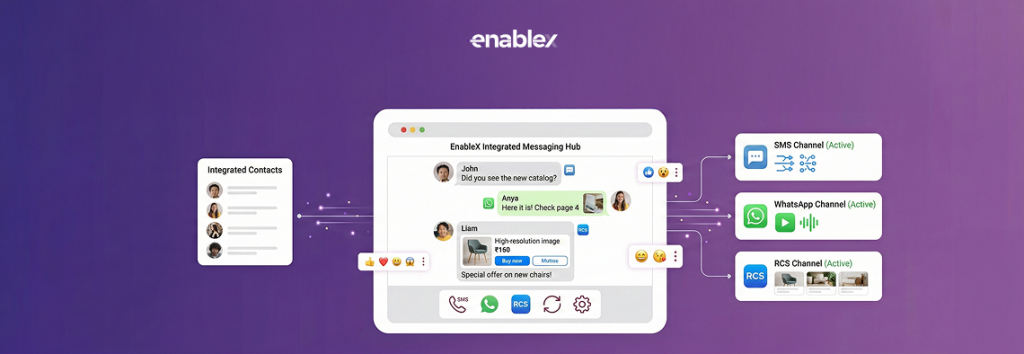
Unify SMS, WhatsApp, and RCS under one intelligent orchestration engine with a single endpoint, smart routing, automatic fallback, unified tracking, and a single webhook.
Single endpoint for SMS, WhatsApp and RCS with a unified payload model.
Route by cost or speed and automatically fail over between channels to prevent message drops.
One webhook and one message ID for statuses, failures and timestamps across all channels.
Intelligent routing and failover to ensure your messages always reach their destination, optimizing for cost and speed.
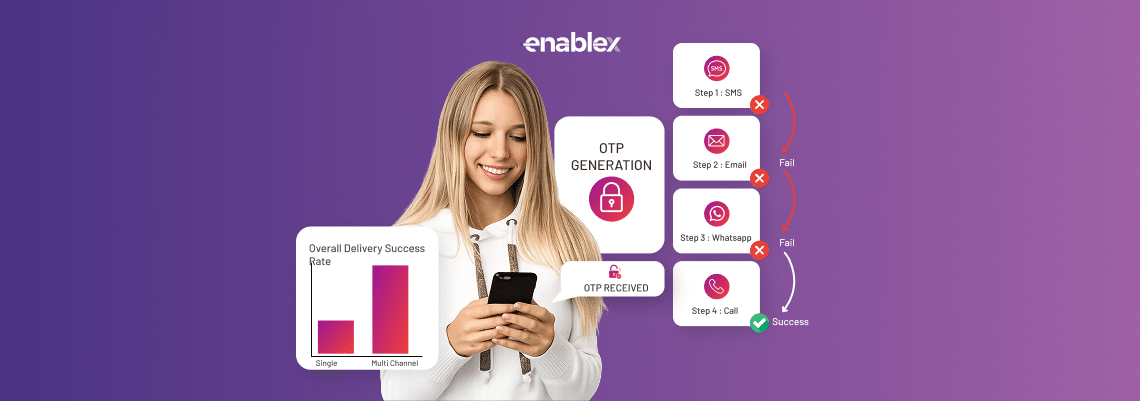
Never miss a delivery. If a message fails, the engine retries on the next channel:
Unlike simple aggregators, EnableX offers full SMS infrastructure, WhatsApp Business API, RCS Business Messaging, an intelligent routing engine, a unified messaging database, and developer‑friendly APIs. This is not aggregation—this is orchestration.
Related Reads:
March 16, 2026 / Team EnableX
March 12, 2026 / Alison Chase
March 9, 2026 / Pankaj Gupta


A unified messaging API is a single integration endpoint that lets you send messages across SMS, WhatsApp Business, RCS, and Voice channels without coding against each provider separately.
The EnableX Omnichannel Unified Messaging API reaches customers in 100+ countries through Tier-1 carrier connections, automatically falls back from RCS to SMS or from WhatsApp to SMS when a channel isn't available, and returns a single delivery receipt format. Developers integrate once; the API handles channel selection, templating, rate limits, and compliance per channel. A no-code workflow builder and self-service broadcast portal are included for business users, so marketing can run campaigns without waiting for engineering.
You send one API call with the recipient number and message payload; EnableX picks the best channel, delivers the message, retries with a fallback channel if needed, and returns a unified status callback.
The API inspects the recipient's registered channels (WhatsApp opt-in, RCS capability, SMS reachability), applies your channel-priority rules, and routes accordingly. Messaging templates, rich media, and quick-reply buttons are rendered natively per channel. All traffic flows through Tier-1 carrier and Meta-partner routes, reaching customers in 100+ countries.
It supports SMS, WhatsApp Business API, RCS Business Messaging, and Voice broadcast from a single integration — with reach into 100+ countries.
Each channel is backed by a dedicated EnableX product — the SMS API for global SMS, the official WhatsApp Business API for two-way conversations and templates, the RCS API for branded rich messaging on Android, and the Voice API for programmable voice broadcast and callbacks. The Video Call API is available from the same account for use cases that need a live video escalation such as Video KYC.
SMS works on every mobile phone globally but supports only 160 characters of plain text. WhatsApp Business API adds rich media, two-way conversations, and templates on top of WhatsApp's 2-billion-plus user base. RCS adds branded rich media (carousels, buttons, verified sender) to the native Android messaging app.
Choose SMS for universal reach and OTPs, WhatsApp for conversational engagement with opted-in customers, and RCS for brand-verified rich marketing in geographies with strong Android penetration. The EnableX Unified Messaging API lets you use all three from one integration and cascade between them.
Channel fallback is automatic retry across messaging channels when the primary channel fails — for example, trying RCS first, then WhatsApp, then SMS if the previous attempt doesn't deliver.
EnableX executes fallback based on your configured priority list, device capability checks, delivery receipt status, and timeout rules. You control the cascade per message type — a transactional OTP might start on SMS, while a marketing push might start on RCS and fall back to WhatsApp Business API.
EnableX is a Tech partner working with multiple WhatsApp Business Solution Providers (BSP), so messages sent through the Unified Messaging API use sanctioned WhatsApp Business infrastructure and comply with Meta's Business Messaging Policy.
You get templated messaging, session-window handling, WhatsApp Business Calling (beta), and full access to Meta's product roadmap for WhatsApp Business API. EnableX manages phone number verification, template approvals, and quality-rating monitoring on your behalf.
Sign up for an EnableX account, generate an API key, and call the /messages REST endpoint with your payload. Most integrations go live in under 48 hours for SMS and RCS, and within a week for WhatsApp Business API after template approvals.
Official SDKs are available for Node.js, Python, Java, PHP, and .NET. The Developer Docs include quickstart tutorials, Postman collections, and webhook samples. WhatsApp Business API requires Facebook Business Manager verification and template approval, which EnableX guides you through. A no-code workflow builder lets non-developers design and launch campaigns without calling the API directly.
Yes. EnableX supports OTP and 2FA delivery across SMS, WhatsApp, and Voice — with automatic fallback between channels to maintain delivery rates above 98%.
OTPs are sent as transactional messages through Tier-1 carrier routes with low-latency delivery. You can configure WhatsApp-first OTP with SMS fallback, or SMS-first with Voice OTP fallback. All variants are supported from the same API call.
Yes. EnableX includes a self-service broadcast portal plus API-level bulk sending across SMS, WhatsApp Business API, RCS, and Voice, with rate-limit handling, scheduled delivery, and per-message tracking built in.
Marketing teams can launch campaigns from the no-code portal without calling the API; engineering teams can submit bulk jobs as arrays or CSV uploads via the API. EnableX paces the job to respect each channel's rate limits (WhatsApp messaging tier, RCS carrier limits, SMS MNP rules) and returns a job-level report plus per-message delivery receipts.
Yes. The EnableX Dialogs Cloud Conversational AI Platform plugs directly into the Unified Messaging API, so your AI Agent can send and receive on SMS, WhatsApp, RCS, and in-app from the same workflow.
The AI Agent is a generative-AI chatbot for enterprises; the AI Voice Agent extends the same platform to voice via PSTN, IP, and WhatsApp Business Calling. Both hand off to human Live Agents with full context when needed.
Yes. Every message dispatched through the API sends a unified webhook event for each status change — sent, delivered, read, failed — regardless of underlying channel.
Webhooks use signed HMAC headers for authentication, support retries with exponential backoff, and can be filtered by channel, event type, or message tag. Inbound messages (customer replies on WhatsApp, RCS, or SMS) are also delivered to your webhook in the same schema.
EnableX is often the stronger choice in India, Southeast Asia, and the Middle East because it offers on-premise and hybrid deployment, white-label for telcos, Arabic-language support on the roadmap, and direct Tier-1 carrier routes in APAC — capabilities Twilio does not offer in these regions.
Twilio's messaging suite is strong globally but is a pure public-cloud service and, since 2023, no longer sells a video product. EnableX keeps full-stack parity across Video, Voice, SMS, WhatsApp, RCS, and Conversational AI — and supports on-prem deployment for regulated buyers in BFSI and government.