Voice Broadcasting & Bulk Voice Calls

AI-Powered Calling That
Personalises Every Conversation at Scale

Thousands of personalized voice calls in minutes. AI Text-to-Speech generates unique and personalized messages for each
recipient – for example, with their names, OTP and Transaction Amounts - in 100+ local languages, including English, Hindi,
various Indic languages, Arabic, Bahasa & Mandarin.

AI-powered voice broadcasting platform with dynamic text-to-speech

AI Voice Broadcasting That Goes Beyond a Simple Call

Voice broadcasting (also called bulk voice calling) lets you deliver AI-generated, personalized voice messages to thousands of phone numbers simultaneously. Each recipient hears a message with their own name, amount, date, and details — generated by neural text-to-speech that sounds natural, not robotic. Schedule, personalize, and optimize in real time for better conversions at scale.

AI Text-to-Speech with Dynamic Variables

Write a template once. The AI generates a unique message for each recipient — inserting their name, amount, date, and policy number in natural-sounding

Live Campaign Analytics

Track call delivery, pickup rates, DTMF responses, and call duration in real time. Get actionable data to optimize messaging and maximize contact rates across India, UAE, Saudi Arabia, and Southeast Asia.

Compliance Built In

DLT and NDNC for India. TRA for UAE. CITC for Saudi Arabia. PDPA for Singapore. Number scrubbing, opt-out handling, and calling-hour enforcement are part of the platform — you don't build compliance logic separately.

AI Voice Broadcasting for Every Business Use Case

Automate outbound calling with AI-generated, personalized voice messages for collections,
renewals, reminders, alerts, and customer engagement.

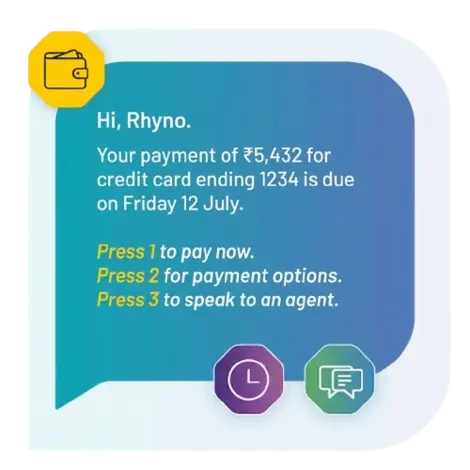
Banks, NBFCs, and lending apps use AI voice broadcasting to remind borrowers about upcoming or overdue payments. Using dynamic variables, each call carries the borrower's name, loan account number, and exact amount due — generated from the bank's database at call time. "Hi Rajesh, your home loan EMI of ₹12,450 for account ending 4421 is due on April 25th. Press 1 to pay now." The borrower presses 1 and gets a payment link via SMS. One insurer reduced lapse rates by 22% after switching to personalized AI calls.

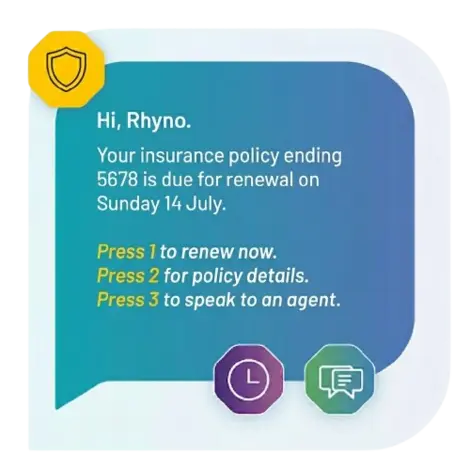
Policy renewals are time-sensitive — a missed renewal means a lapsed policy and lost revenue. AI voice campaigns run at 30, 15, and 7 days before expiry. Each call is generated dynamically with the policyholder's name, policy number, product type, premium amount, and due date. The AI TTS reads "Hi Meena, your health insurance policy HI-334201 is up for renewal on May 15th. The premium is ₹18,400. Press 1 to renew now, press 2 for a callback from your advisor."

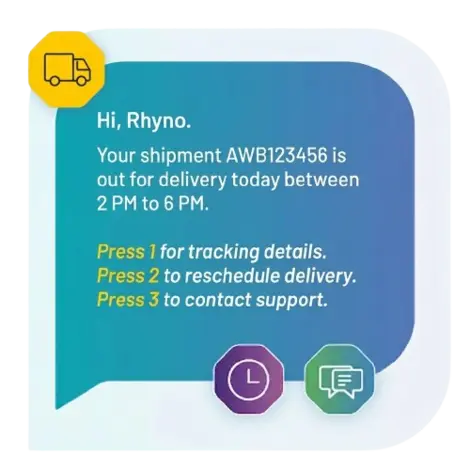
"Your order is out for delivery. Press 1 to confirm your address. Press 2 to reschedule." Quick, clear, and the customer doesn't need to open an app. Particularly effective in markets where customers may not regularly check SMS — which is most of South and Southeast Asia. Pair voice broadcasts with WhatsApp notifications as a fallback channel for maximum reach.

Hospitals and diagnostic labs use voice broadcasts to confirm appointments 24 hours in advance. No-shows cost healthcare providers money. A personalized AI call — "Your appointment with Dr. Sharma is tomorrow at 3 PM. Press 1 to confirm, press 2 to reschedule" — brings no-show rates down by 25-40%. For teleconsultation follow-ups, the system can escalate directly to a video call with the doctor.

Natural disasters, public health alerts, evacuation notices, election reminders. Government agencies in India and the Middle East use voice broadcasting to reach citizens who may not have smartphones or data connectivity. Voice works on every phone — feature phones included. Multi-language AI TTS means the same alert can go out in Hindi, Arabic, Tamil, and English simultaneously without recording a single audio file.

Protect your business and users with voice-based OTPs and two-factor authentication. AI text-to-speech delivers secure, repeatable one-time passwords — ensuring critical verifications reach users clearly, even without internet access. Works alongside SMS OTP as a fallback channel for higher delivery rates.

AI voice broadcasting for BFSI collections

AI-Powered Voice Broadcasting with Smart Capabilities

From neural text-to-speech with dynamic variables to conversational AI voice agents —
everything you need for personalized outbound calling at scale.

AI Text-to-Speech with Dynamic Variables

Write a template with {name}, {amount}, {date} placeholders. Neural TTS generates unique, natural-sounding audio for each recipient — in Hindi, Arabic, Bahasa, Tamil, or 11 other languages. No recording studio needed.

Pre-Recorded Audio Upload

Upload your own .mp3 or .wav recordings for a consistent, branded voice experience. Use alongside AI TTS — pre-recorded for the greeting, dynamic TTS for the personalized details.

Multi-Language Neural TTS

15+ languages with native speaker voice quality. Hindi-English code-switching. Gulf Arabic vowelization. Bahasa Indonesia number formatting. The AI handles "₹12,450" as "barah hazaar chaar sau pachaas rupaye" — not a string of digits.

DTMF + Call Transfer

Recipients press keys to take action — confirm a delivery, connect to an agent, opt out. Press 1 triggers an SMS payment link. Press 2 transfers to an AI voice agent for two-way conversation.

Scheduled Broadcasting

Set up campaigns in advance to run at specific times. Stagger delivery across time zones. TRAI calling window enforcement (9 AM - 9 PM) for India. Local regulation compliance for UAE, Saudi Arabia, Singapore.

Real-Time Campaign Analytics

Monitor delivery status, pickup rates, call duration, DTMF responses, and retry outcomes. Dashboard view for ops teams. Webhook callbacks for developers to pipe data into CRM or collections systems.

100K Concurrent Calls

Send thousands of voice messages simultaneously without compromising quality. Most campaigns of 10,000–50,000 calls complete within 15–30 minutes. Smart retry logic for unanswered calls.

Omnichannel Fallback

If a voice call doesn't connect, trigger a WhatsApp message or SMS as fallback — automatically, from the same platform with one API key and one billing account.

More Features   arrow

Two Ways to Send Voice Broadcasts

Campaign Cloud dashboard for marketing and ops teams. Voice API for developers.
Same platform, same billing, same analytics.

Campaign Cloud Dashboard (No Code)

Upload your contact list. Write your AI TTS template with variables — or record audio. Set the schedule. Hit send. The dashboard handles everything including DLT compliance, retry logic, and real-time reporting.

Voice API (Full Programmatic Control)

Build voice broadcasting into your own application. Trigger calls when an EMI is overdue or a delivery is dispatched. Pass per-recipient variables via the API. Receive webhook callbacks for every call event.

AI Voice Broadcasting in Three Simple Steps

Our self-service portal makes it easy to launch personalized campaigns.

1

Create Your Message

Record audio, or write an AI TTS template with dynamic variables like {name}, {amount}, {due_date}. Choose language and voice.

2

Upload Your Contact List

Import contacts in Excel or CSV with personalization fields. The AI generates a unique audio message for each recipient.

3

Launch & Monitor

Send now or schedule. Track delivery, pickup rates, DTMF responses, and call duration in real time.

Going Beyond Broadcasting: AI Voice Agents for Two-Way Calls

Standard voice broadcasting is one-directional — play a message, capture a keypress, end call. An AI voice agent can hold a short conversation: ask questions, understand spoken answers, handle objections ("I already paid"), switch languages mid-call, and escalate to a human agent when needed.

Example: an NBFC runs 20,000 collection calls per day. The AI voice agent greets each borrower by name, states the overdue amount, negotiates payment dates, and reconciles disputed payments — all without human intervention. EnableX Dialogs Cloud powers this on top of the Voice API.

Feature Voice Broadcasting AI Voice Agent
Direction One-way Two-way conversation
Input DTMF keypresses Natural speech
Languages 15+ TTS 15+ TTS + ASR
Code-switching TTS only TTS + recognition
Use Case Alerts & reminders Collections, surveys, lead qualification

Related EnableX Products

Voice Call API

Build custom AI voice experiences — IVR, call bridging, number masking, and outbound calling — with developer-friendly APIs and SDKs.

Voice API arrow

AI Voice Agent

AI Voice Agent

Two-way AI conversations for collections, lead qualification, appointment scheduling, and customer support. Powered by Dialogs Cloud.

AI Voice Agent arrow

Omnichannel Campaigns

Combine voice broadcasting with SMS, RCS, and WhatsApp to build consistent campaigns across the entire customer journey.

Campaigns Cloud arrow

Frequently Asked Questions on Voice Broadcasting

1. What is the difference between voice broadcasting and bulk voice calling?

up arrow down arrow

They're the same thing. "Voice broadcasting" and "bulk voice call" both refer to sending a pre-recorded or AI text-to-speech message to a large number of phone numbers simultaneously. Some providers also use the term "robocalling" — same concept, though that term carries negative connotations in North American markets. The technology, pricing, and compliance requirements are identical regardless of what you call it.

2. How many calls can I send at once with voice broadcasting software?

up arrow down arrow

EnableX supports up to 100,000 concurrent outbound calls per campaign. The actual throughput depends on your account configuration and the destination network's capacity. Most campaigns of 10,000–50,000 calls complete within 15–30 minutes.

3. Can I personalize each voice broadcast call for individual recipients?

up arrow down arrow

Yes. Using AI text-to-speech with dynamic variable templates, you can insert recipient-specific data into the message — their name, account number, amount due, appointment time, order ID, or any custom field from your database. The AI TTS engine generates a unique audio for each call, producing natural-sounding speech that reads the personalized data as a human would. For example, "₹12,450 due on 25th April" is spoken as "barah hazaar chaar sau pachaas rupaye, pachees April ko" in Hindi — not a string of digits.

4. Does AI text-to-speech sound natural enough for business voice broadcasts?

up arrow down arrow

Current neural TTS models are significantly better than the robotic voices from a few years ago. EnableX uses AI voice models trained on hundreds of hours of native speaker audio per language. The output handles natural pauses, rising and falling intonation, number-to-word conversion, and contextual emphasis. Pickup-to-completion rates on AI TTS campaigns are within 5% of human-recorded voice campaigns. For personalized content — where pre-recording isn't possible — AI TTS actually outperforms because the message carries the recipient's specific data, which keeps them on the line.

5. Do I need DLT registration to send bulk voice calls in India?

up arrow down arrow

Yes. TRAI mandates DLT registration for all commercial voice communication in India. You need to register your business entity, phone numbers (headers), and message templates on a DLT platform through any authorized telecom operator — Jio, Airtel, Vodafone Idea, or BSNL. EnableX provides step-by-step guidance for this process.

6. What is an AI voice calling agent and how is it different from voice broadcasting?

up arrow down arrow

An AI voice calling agent (also called an AI voice bot) is a two-way automated caller that can hold a short conversation — not just play a message. It asks questions, understands spoken answers, handles objections, and takes action based on what the customer says. Standard voice broadcasting is one-directional: play a message, capture a keypress, end call. An AI voice agent adds natural language understanding so it can respond dynamically. EnableX's Dialogs Cloud powers AI voice agents that sit on top of the Voice API.

7. Can the AI handle Hindi-English code-switching during calls?

up arrow down arrow

Yes. EnableX's AI TTS and speech recognition handle code-switching — where the speaker mixes Hindi and English in the same sentence, which is how most urban Indian consumers actually speak. The TTS engine can generate mixed-language output, and the speech recognition engine can understand mixed-language responses from callers. This is also relevant for Arabic-English switching in UAE and Bahasa-English in Southeast Asia.

8. Is voice broadcasting legal in UAE and Saudi Arabia?

up arrow down arrow

Yes, with compliance requirements. In the UAE, the TRA regulates automated calling. Transactional and service calls (appointment reminders, delivery alerts) are permitted with customer consent. Promotional bulk calls face stricter rules. In Saudi Arabia, CITC governs commercial communications, and campaigns must include Arabic opt-out options. EnableX handles compliance checks for both markets.

9. What happens if the voice broadcast call is not answered?

up arrow down arrow

You configure retry logic. Set how many times the system should retry (typically 2–3 attempts) and the interval between retries (30 minutes, 1 hour, etc.). After all retries are exhausted, the call is marked as undelivered. You can then trigger a fallback — an SMS or WhatsApp message — through the same EnableX platform.

10. What languages are supported for text-to-speech in voice broadcasts?

up arrow down arrow

EnableX text-to-speech supports 15+ languages including English, Hindi, Arabic, Bahasa Indonesia, Bahasa Malay, Tamil, Telugu, Kannada, Bengali, Tagalog, Thai, Vietnamese, Mandarin, and Japanese. Multiple voice options (male/female) are available for most languages.

11. Can I use AI to decide the best time to call each recipient?

up arrow down arrow

Yes, through API-level logic. While EnableX handles the calling infrastructure, you control the scheduling. Many companies feed call attempt data back into their systems and use their own models to determine optimal call times per recipient — based on past pickup patterns, time zone, day of week, and historical response rates. The Voice API's webhook callbacks give you the data to optimize scheduling. Some enterprises report 15–20% higher contact rates after implementing optimized call scheduling on top of EnableX.

12. Can I send bulk voice calls from my own phone number?

up arrow down arrow

Yes. You can provision your own virtual numbers or bring existing numbers for caller ID. In India, numbers must be DLT-registered. In other markets, EnableX provisions local or toll-free numbers for you. Using a recognizable caller ID improves pickup rates significantly — campaigns using branded numbers see 30–40% higher answer rates compared to unknown numbers.

13. How is voice broadcasting different from a cloud contact center?

up arrow down arrow

A contact center handles two-way conversations between agents and customers. Voice broadcasting is one-to-many: you send a message to thousands of people at once. The two often work together — a broadcast campaign might offer "press 1 to speak with an agent," which then routes to your contact center. EnableX supports both through the Voice API and Campaign Cloud.

14. Can I schedule a voice broadcasting campaign?

up arrow down arrow

Yes. EnableX allows users to set the start date and time for their campaigns, enabling you to reach your audience at the most effective moment. This scheduling feature is available both through the Campaign Cloud dashboard and via API integration, making it convenient for businesses to plan and automate their outreach in advance.