IVR Service Provider

AI-Powered Interactive Voice Response
Set Up in 48 Hours

Route inbound calls with AI-powered voice menus, personalized TTS greetings, and dynamic menu trees
that adapt to each caller. API access + no-code builder. 15+ languages. On-premise deployment available.

AI-powered voice broadcasting platform with dynamic text-to-speech

IVR That Knows Who's Calling — Before They Press a Button

Your customer calls. The IVR identifies them from their phone number, pulls their profile from your CRM, and greets them by name with their account context — all using AI text-to-speech generated in real time. "Hi Meena, welcome to ACME Bank. Your savings account ending in 7302 has a balance of eighteen thousand four hundred rupees. For recent transactions, press 1."

That's modern IVR. It handles the first 60-70% of inbound calls without a human picking up the phone. The customer gets an answer in seconds. Your agents handle only the calls that actually need a person.

Personalized AI Greetings

The IVR pulls caller data from your CRM and generates a personalized greeting using AI TTS — their name, account balance, last interaction — in Hindi, Arabic, English, or any of 15+ languages. No pre-recorded audio needed.

Dynamic Menu Trees

The menu adapts to who's calling. A customer with an overdue payment hears payment options first. A VIP customer skips the queue entirely. Menu structure changes per caller — controlled by your API logic.

On-Premise Deployment

Banks regulated by RBI, SAMA, or MAS can't send call recordings to third-party clouds. EnableX deploys the entire IVR stack — routing, recording, AI, analytics — behind your firewall.

Three Types of IVR — Which One You Need

From basic press-1 menus to AI-powered conversational voice — choose the right IVR for your business.

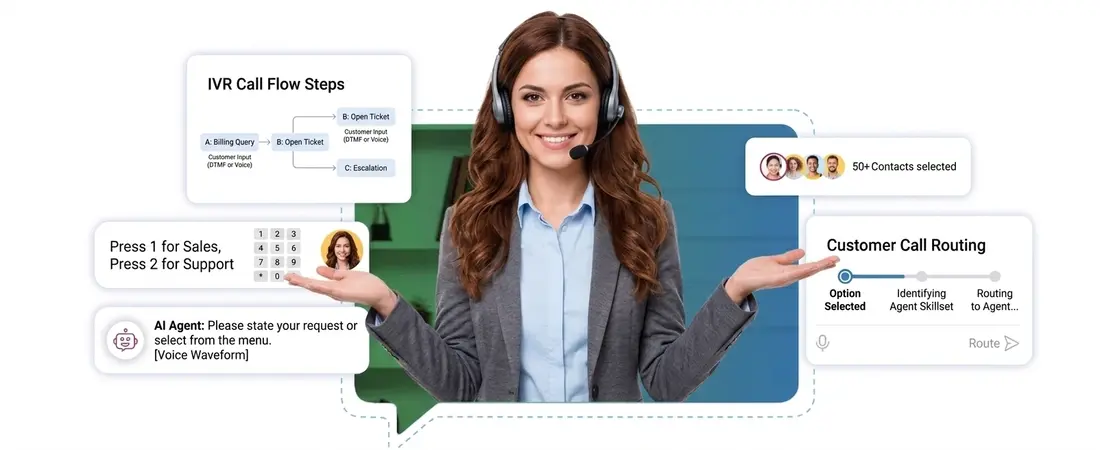
The standard. Caller hears a menu, presses keys on their phone. The system routes the call based on their input. Works on every phone — smartphones, feature phones, landlines. Good for straightforward routing where you have 4-5 menu options. Banks use it for balance inquiry, transaction status, card blocking. Hospitals use it for appointment booking vs. emergency vs. lab results. Limitation: if your menu has more than 3 levels, callers get frustrated.

Instead of pressing buttons, the caller speaks. "I want to check my loan status." The AI uses speech recognition and natural language understanding to interpret the request. It handles Hindi-English code-switching ("mera loan ka status check karna hai, account number eight eight four two one"), disambiguation ("which bill — electricity or credit card?"), and context retention across the conversation. EnableX's AI Voice Agent powers this — supporting Hindi, English, Arabic, Bahasa, Tamil, Telugu, and Tagalog.

The caller dials in, and instead of listening to a voice menu, they see options on their phone screen — tappable buttons, forms, even maps. The voice call stays connected while the customer navigates visually. This works when the customer needs to do something hard to do with their voice — selecting from a long list, entering an email, uploading a document. EnableX supports visual IVR through its Video API — the caller's screen shows an interactive interface while the voice channel stays open.

DTMF IVR service for call routing

AI-Powered IVR with Smart Capabilities

From caller-aware AI greetings to dynamic menu trees and intelligent agent routing —
everything you need for a modern IVR that actually works for your customers.

AI Text-to-Speech with Caller Data

The IVR pulls the caller's profile from your CRM and generates a personalized greeting using neural TTS — their name, balance, last transaction — in Hindi, Arabic, Bahasa, or 12 other languages. Every greeting is unique.

Dynamic Variable Menus

Menu options change per caller based on their data. A customer with an overdue EMI hears payment options first. A delivery-day caller hears tracking status. Your API tells the IVR which menu tree to load for each caller.

Conversational AI (NLU)

Callers speak naturally instead of pressing keys. The AI extracts intent and entities from speech — handling Hindi-English code-switching, Arabic dialects, and multi-turn context. Powered by EnableX AI Voice Agent.

Multi-Level DTMF Menus

Support up to 10 menu levels with keypad input. DTMF responses trigger actions — route to agent, play information, send SMS, transfer to video call. Each response logged to your webhook.

15+ Language TTS

Neural text-to-speech in Hindi, Arabic, Bahasa Indonesia, Bahasa Malay, Tamil, Telugu, Bengali, Tagalog, Thai, Vietnamese, and more. Language selection at first menu level, then entire flow in chosen language.

CRM Integration via Webhooks

Every IVR event — caller input, menu selection, transfer — triggers a webhook to your server. Look up customer data in Salesforce, Zoho, Freshdesk, ServiceNow, or any system with an API. Personalize the experience in real time.

On-Premise Deployment

Deploy the entire IVR stack — call routing, recording, AI processing, analytics — within your data center. Required by banks regulated by RBI, SAMA, or MAS, and government agencies with data sovereignty mandates.

Recording & Analytics

Every call recorded with configurable retention. Analytics cover call volume, handling time, menu traversal paths, drop-off points, and agent utilization. Dashboard for ops teams, API for developers.

More Features   arrow

IVR Use Cases by Industry

From banking to healthcare, logistics to government — how enterprises across
India, UAE, Saudi Arabia, and Southeast Asia use AI-powered IVR.

Inbound: The IVR identifies the caller, pulls their profile, and greets them by name with account context using AI TTS: "Hi Suresh, your savings account ending in 7302 has a balance of ₹2,14,500. For recent transactions, press 1." Generated in Hindi, English, Tamil, or Arabic depending on the caller's language preference.

Outbound: EMI reminders with personalized amounts and due dates. Fraud alert calls with specific transaction details. Each call generated dynamically by the AI TTS engine.

Why EnableX: On-premise deployment for RBI/SAMA compliance. Same platform handles the IVR, the SMS OTP, and Video KYC if needed.

Inbound: Policy status, claim registration, premium due dates. A well-designed IVR handles 60-70% of these queries without an agent. AI Voice Agent handles the conversational complexity — "I need to add my daughter to my health insurance policy" is hard to route through a press-1 menu. Conversational IVR handles it naturally.

Outbound: Renewal reminders, POSP lead qualification, post-claim surveys — all with per-policyholder data generated by AI TTS.

Inbound: Appointment booking, lab report status, doctor availability, department routing.

Outbound: Appointment reminders (reduces no-shows by 25-40%), prescription refill alerts, follow-up scheduling. The IVR can escalate directly to a video call with the doctor — patient calls for a follow-up, the IVR confirms identity, and connects them to a teleconsultation.

Citizen services — property tax status, utility bills, driving license renewal, pension status. Multilingual IVR is critical: Hindi + English + regional language in India; Arabic + English in UAE and Saudi Arabia. On-premise deployment for data sovereignty. Bulk voice broadcasting for mass notifications through the same platform.

With caller identification and AI TTS, the IVR skips the generic menu for callers with active orders: "Hi Dewi, your order of 3 items from TechMart is out for delivery and will arrive by 4 PM today. Press 1 for live tracking." The IVR then sends a WhatsApp message with the tracking link. One platform, no integration headaches.

IVR for banking and financial services

Two Ways to Build Your IVR

Campaign Cloud no-code builder for ops teams. Voice API for developers.
Same platform, same billing, same analytics.

No-Code IVR Builder

Create menu trees, record or generate AI TTS prompts, set routing rules, and go live without writing any code. If you later need CRM integration, dynamic menus, or WhatsApp handoffs — switch to the Voice API without rebuilding.

Voice API — Full Control

Build data-driven IVR flows programmatically. Caller lookup via webhook → personalized AI TTS greeting → dynamic menu based on caller data → CRM update on every interaction.

IVR Setup in Three Steps

Basic DTMF IVR goes live in 48 hours. Multi-level with CRM integration in 10-15 business days.

1

Design Your Call Flow

Map menu options, routing rules, AI TTS prompts with variables, and CRM integrations.

2

Configure & Integrate

Set up IVR menus, TTS language/voice, DTMF logic, API callbacks to your CRM and backend systems.

3

Test & Go Live

End-to-end testing across all menu paths. Number provisioning. Load testing for peak volumes. Launch.

Related EnableX Products

Voice Call API

Build custom voice call flows — IVR, call bridging, number masking, outbound calling — with full programmatic control.

Voice API arrow

AI Voice Agent

AI Voice Agent

Upgrade from DTMF to conversational AI. Two-way voice interactions for collections, support, and lead qualification.

AI Voice Agent arrow

Voice Broadcasting

Outbound bulk voice calls with AI TTS personalization. Same platform as your IVR — one API key, one dashboard.

Voice Broadcasting arrow

Frequently Asked Questions on IVR Service

1. What is an IVR service provider?

up arrow down arrow

An IVR service provider is a company that supplies the technology for interactive voice response systems — the automated phone menus businesses use to route incoming calls, collect caller input, and deliver information without a live agent. Providers like EnableX offer this as a cloud service (or on-premise deployment) with APIs, dashboards, and pre-built integrations so businesses can set up IVR without buying hardware.

2. How much does IVR cost per month?

up arrow down arrow

IVR pricing typically ranges from $50 to $500 per month for small and mid-size setups, depending on concurrent call capacity and minutes used. Enterprise deployments with AI, multi-language TTS, and high concurrency run higher. EnableX uses a pay-as-you-go model — base platform fee plus per-minute charges. No per-seat fees for the IVR itself. See the Voice API pricing page for details.

3. Which is the best IVR service provider in India?

up arrow down arrow

The answer depends on what you need. For basic DTMF IVR with quick setup, Exotel, Knowlarity, and MyOperator are popular in India. For businesses that need programmable APIs, AI-powered conversational IVR, on-premise deployment (required by RBI-regulated banks), and multi-channel capabilities (voice + SMS + WhatsApp on one platform), EnableX covers all of these. EnableX is also the stronger choice if you operate across India, UAE, Saudi Arabia, or Southeast Asia — most Indian providers don't serve those markets.

4. Can I set up IVR without coding?

up arrow down arrow

Yes. EnableX Campaign Cloud includes a no-code IVR builder where you can create menu trees, generate AI TTS prompts, set routing rules, and go live without writing any code. If you later need CRM integration, dynamic menus based on caller data, or WhatsApp handoffs — switch to the Voice API without rebuilding from scratch.

5. How long does it take to set up IVR?

up arrow down arrow

A basic DTMF IVR — single menu level, call routing to a few departments — can go live in 48 hours. A multi-level IVR with CRM integration, AI voice recognition, and custom business logic takes 10–15 business days. The biggest variable is usually internal decision-making on call flow design, not the technology setup.

6. What is conversational IVR and how is it different from regular IVR?

up arrow down arrow

Conversational IVR replaces the "press 1, press 2" menu with natural language interaction. The caller speaks their request and an AI engine interprets the intent, extracts details, and takes action. EnableX powers conversational IVR through its AI Voice Agent in Dialogs Cloud, supporting Hindi, English, Arabic, Bahasa, and 10+ other languages with code-switching capability.

7. Can AI personalize the IVR greeting for each caller?

up arrow down arrow

Yes. When a known customer calls, the IVR makes an API callback to your CRM, retrieves the caller's profile, and uses AI text-to-speech to generate a personalized greeting in real time. For example: "Hi Priya, your fixed deposit of ₹5,00,000 matures on June 15th. Press 1 for renewal options." The neural TTS generates this as one natural, fluid sentence — not spliced audio clips. If the caller isn't recognized, a generic fallback greeting plays instead.

8. Can the IVR show different menus to different callers?

up arrow down arrow

Yes, through dynamic menu trees. When a call arrives, your server tells the IVR which menu to load for that specific caller based on their profile, transaction history, or account status. A customer with an overdue payment hears payment options first. A VIP customer skips the menu entirely. The menu structure changes per caller, per call — all controlled through your API logic, executed by EnableX's IVR engine.

9. Can the AI handle callers who speak in a mix of two languages?

up arrow down arrow

Yes. EnableX's speech recognition models handle code-switching — mixing Hindi and English, Arabic and English, or Bahasa and English in the same sentence. A caller saying "mera order ka status kya hai, order number seven five three two" is understood correctly as a single intent with a single entity, across two languages.

10. Does IVR work on mobile phones and landlines?

up arrow down arrow

Yes. IVR works on every type of phone — smartphones, feature phones, and landlines. The caller doesn't need a data connection, an app, or a smartphone. This is why IVR remains critical in markets like India and Southeast Asia where a large portion of customers still use feature phones.

11. Can IVR connect to my CRM or ticketing system?

up arrow down arrow

Yes. Through API callbacks, every IVR event triggers a webhook to your server. You can use this to look up customer data in Salesforce, Zoho, Freshdesk, ServiceNow, or any system with an API. The IVR then personalizes the experience — greeting the caller by name, reading out their account balance, or routing them to their assigned relationship manager.

12. What's the difference between an AI voice bot and conversational IVR?

up arrow down arrow

Conversational IVR is the front door — it answers inbound calls and routes or resolves. An AI voice bot can do everything conversational IVR does, plus make outbound calls, hold multi-turn conversations, handle objections, and take actions. Think of conversational IVR as the inbound receptionist and the AI voice bot as a full telephone agent. EnableX supports both through the Voice API and Dialogs Cloud.