Voice Bot vs IVR vs AI Voice Agent: What Is the Difference?

An IVR is a phone menu ("press 1 for billing"). A voice bot understands spoken requests, but only follows a fixed script with a set list of intents. An AI voice agent uses a large language model to hold a free-flowing conversation, look up data in your systems, finish the task, and hand the call to a person when it should. Most businesses now keep IVR for simple routing and move their high-volume, repeatable calls to AI voice agents.
Every business that takes phone calls has to answer the same question: how much of this can a machine handle without making customers angry? The technology has moved on several times, and each step brought new terms. Today "IVR", "voice bot" and "AI voice agent" are used as if they mean the same thing. They don't, and picking the wrong one costs you either money or customers.
Each one still has a place. What matters is knowing which calls belong where, and how to move between them without breaking what already works. This guide explains voice bot vs IVR vs AI voice agent in plain terms: how each one works, what it costs, and which one fits your calls.
What are the three ways to automate a phone call?
There are three: an IVR menu that callers navigate with keypresses, a voice bot that matches spoken requests to a fixed script, and an AI voice agent that holds a real conversation and completes tasks. Each step up handles more of what callers actually say, at a higher running cost.
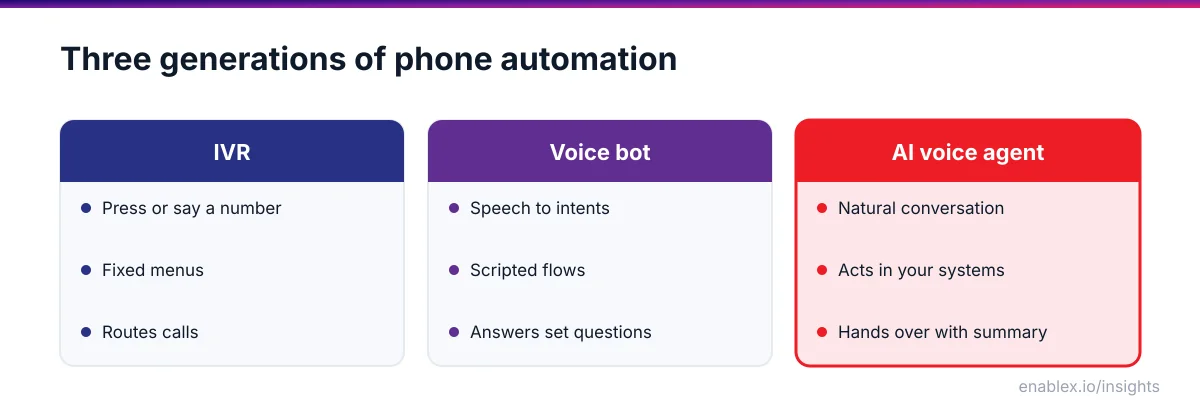
What the figure shows: Three generations of phone automation: IVR (press or say a number, fixed menus, routes calls); Voice bot (speech to intents, scripted flows, answers set questions); AI voice agent (natural conversation, acts in your systems, hands over with summary).
IVR: the phone menu
Interactive Voice Response (IVR) plays recorded prompts and waits for the caller to press keys or say a few fixed words. "Press 1 for account balance. Press 2 to speak to an agent."
IVR is predictable, cheap to run and easy to audit. But it makes the caller do the work. They must listen to every option, guess which bucket their problem fits, and start again if they guess wrong. Deep menus are the main reason callers keep pressing 0.
Voice bot: the scripted assistant
A voice bot adds speech recognition and intent matching. The caller can say "I want to check my balance" instead of pressing 1. Behind the scenes, the bot maps the sentence to a known intent and runs a pre-built dialogue flow.
This is a real step up, and some vendors call it "conversational IVR". The limit is the script. A voice bot only knows the intents someone trained it on. Ask something slightly outside them, or answer two questions in one sentence, and it falls back to "Sorry, I did not get that."
AI voice agent: the conversation
An AI voice agent combines three parts: speech-to-text to hear the caller, a large language model (LLM) to understand and decide, and text-to-speech to reply in a natural voice. Some newer setups do this in one speech-to-speech model.
Better understanding is only half of it. An agent can call your systems in the middle of a conversation. It can check an order, update a policy or book a slot, then confirm the result to the caller. It keeps context across the call, copes when people interrupt, and knows when to pass the call to a human.
How do IVR, voice bots and AI voice agents compare?
The table below compares them on how they understand callers, what they can do and how much upkeep they need. In short, IVR is cheapest and most rigid, voice bots handle narrow questions, and AI voice agents handle open conversation and real tasks.
IVR | Voice bot | AI voice agent | |
|---|---|---|---|
How it understands | Key presses or a few fixed words | Speech mapped to a trained list of intents | Natural speech, understood in context by an LLM |
What it can do | Route calls, play information | Answer FAQs, run set flows | Hold a conversation and complete tasks through your systems |
When the caller goes off-script | Repeats the menu | "Sorry, I didn't get that" | Asks a follow-up, or hands over with context |
Interruptions | Not supported | Limited | Built in (barge-in) |
Effort to change | Re-record and re-map menus | Retrain intents, redraw flows | Edit instructions, knowledge and tools |
Handoff to a human | Cold transfer | Transfer, often without context | Transfer with a call summary |
Best for | Simple routing, compliance prompts | Narrow, stable, high-volume questions | Collections, renewals, bookings, support, lead qualification |
When should you keep an IVR?
Keep an IVR wherever the job really is a short menu: language selection, simple routing, secure keypad entry and very low call volumes. Replacing a working menu with AI in these spots adds cost without helping the caller.
IVR is not dead, and replacing it everywhere is a mistake. Keep it where the job really is a menu:
- Language selection and legally required notices at the start of a call
- Simple routing with three or four clear choices
- Secure keypad entry, such as a PIN or card digits, where you want no speech captured
- Very low call volumes, where the cost of anything smarter is hard to justify
Where do voice bots fall short?
Voice bots work well when the questions are narrow and rarely change: "What is my balance?", "Where is my order?". They struggle with the way people actually talk.
A caller says, "I paid last week but the app still shows it due, and can I move my payment date?" That's two intents, one of them a complaint. A scripted bot picks one or gives up. Every new question means another intent to train and another branch to maintain. After a year, many teams find they are spending more time looking after the bot than it saves.
A real-world example: A healthcare provider we worked with used a simple IVR for appointment calls. Patients had to sit through menus, and many hung up or pressed 0 to reach the front desk. After moving appointment booking, reminders and rescheduling to an AI voice agent, patients could simply say what they needed and finish the task in the same call. More patients now complete their calls, more confirm or reschedule instead of missing visits, and front-desk staff spend their time on patients who need a person. Calls the agent cannot resolve go to staff with a summary, so patients do not repeat themselves.
What makes an AI voice agent different from a voice bot?
An AI voice agent understands what the caller means, takes action in your systems, copes with interruptions and knows when to hand over to a person. It also needs to reply fast, because a slow answer breaks the conversation however smart the model is.
- It understands what the caller means rather than matching keywords. Callers can explain their problem in their own words and in their own order.
- It takes action: Through API calls to your CRM, core banking, policy or booking system, it finishes the job instead of only giving information.
- It handles real conversation: Callers can interrupt, change their mind or correct a detail without the call falling apart.
- It knows its limits: Good agents follow rules on when to escalate, such as anger, a high-value request or a regulatory trigger. They pass the call to a person along with a summary, so the customer does not have to repeat themselves.
- It improves from transcripts: Every call is recorded as text, so you can see exactly where conversations go wrong and fix the instructions.
Speed matters as much as intelligence. If a reply takes more than about a second, the caller starts talking over the agent and the call goes badly. Response time depends on the whole chain, including telephony, speech recognition, the model and voice synthesis as well as the model, which is why the platform underneath matters so much.
How much does each option cost?
IVR costs the least per minute, voice bots add build and upkeep costs, and AI voice agents are usually billed per minute of conversation plus telephony. The fair comparison is cost per resolved call, because an option that resolves more calls can cost less overall.
The cost models are different, so compare cost per resolved call rather than cost per minute.
- IVR: low per-minute cost, but every call it fails to resolve still reaches a human agent.
- Voice bot: moderate running cost, plus ongoing effort to build and maintain intents.
- AI voice agent: usually billed per minute of conversation, plus telephony. The rate depends on the speech and language models you choose. Because it resolves more calls end to end, the cost per resolved call is often lower even when the per-minute rate is higher.
At EnableX, Voice AI is billed per minute, and the rate depends on the models used. Telephony is billed at local carrier rates. We cover the full math in AI Voice Agent Pricing.
Which one should you use?
Use an IVR for simple menus, a voice bot for a few narrow, high-volume questions, and an AI voice agent for conversations that need understanding and action. Most businesses end up running a mix, with the AI agent taking over call types one at a time.
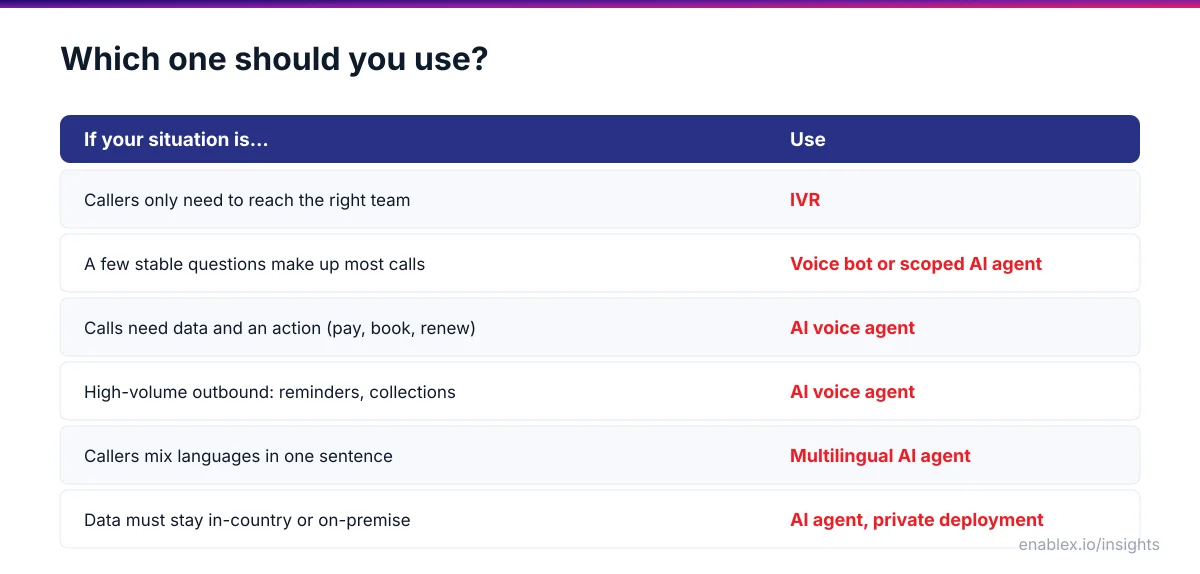
What the figure shows: Which one should you use? Callers only need to reach the right team: IVR; A few stable questions make up most calls: voice bot or scoped AI agent; Calls need data and an action (pay, book, renew): AI voice agent; High-volume outbound: reminders, collections: AI voice agent; Callers mix languages in one sentence: multilingual AI agent; Data must stay in-country or on-premise: AI agent, private deployment.
How do you move from IVR to an AI voice agent safely?
Start with one high-volume, low-risk call type, keep the IVR as the front door, and set handover rules before writing the script. Test with real call audio and track resolution, handover, call length and customer feedback before adding the next call type.
- Pick one call type: Choose a high-volume, low-risk call such as payment reminders, appointment confirmations or order status. Don't start with complaints.
- Keep the IVR as the front door at first. Add an option like "Or just tell me what you need," and send those callers to the agent. You get real traffic without a big-bang switch.
- Write the handoff rules before the script. Decide when the agent must transfer, and make sure the human agent receives the summary.
- Test with real call audio. Use background noise, accents and people talking over each other. Demos in a quiet room hide the problems you will meet on day one.
- Measure four numbers: Containment rate (calls fully resolved), handoff rate, customer satisfaction and cost per resolved call. Expand to the next call type only when all four hold up.
What does EnableX offer for AI voice agents?
EnableX runs telephony, voice AI and human handoff on one platform. You don't need to wire a phone provider, a speech vendor and a bot builder together yourself. Today EnableX handles more than 10 million conversations a month across voice, video and messaging for customers in 20+ countries.
- Every EnableX Voice AI package includes live handover to a human agent, with a call summary.
- You can deploy hosted, in a private cloud or on-premise, for teams with data residency rules.
- Voice AI runs on the same platform as the EnableX Voice API, SIP and phone numbers. One contract covers it all, with no stitching between vendors.
- Billing is per minute, and you can start with the free trial wallet credit, which works across all EnableX services.
Hear it for yourself: listen to live AI voice agent demos for collections, renewals and appointment booking on our Voice AI demo page, or start a free trial.
Frequently asked questions
Is a voice bot the same as an AI voice agent?
No. A voice bot follows a fixed script and recognizes a set list of intents. An AI voice agent uses a large language model to understand open-ended speech, keep context and complete tasks through your business systems.
What is conversational IVR?
Conversational IVR lets callers say what they need instead of pressing keys. Older versions are voice bots with intent matching. Newer versions put an AI voice agent behind the IVR, so callers can speak naturally and get the task done in the same call.
Can an AI voice agent replace my IVR completely?
It can, but most businesses keep a short IVR step for language choice, legal notices or secure keypad entry, and send everything else to the AI voice agent.
Do AI voice agents work in languages other than English?
Yes. Modern speech models support many languages, and some handle callers who mix two languages in one sentence. EnableX Voice AI supports English, all major Indian languages, Southeast Asian and European languages, and Arabic.
How are AI voice agents priced?
Most are priced per minute of conversation, plus telephony charges. The rate depends on the speech and language models used. EnableX bills Voice AI per minute and charges telephony at local carrier rates.
Founder and CEO, EnableX
Pankaj Gupta has spent 25+ years building IT and telecom businesses across Asia-Pacific and global markets. EnableX is his third company; the first two were built from zero and acquired by global companies. He also invests in B2B startups and mentors founders across the region.
Connect on LinkedIn →