AI Voice Agent Pricing: What a Minute Really Costs

Most AI voice agents are priced per minute of conversation. That rate bundles speech recognition, the language model, voice synthesis and the platform that runs them. Telephony, phone numbers and extras such as recording are usually charged on top. The model choice moves the price most: a premium voice and a large model can cost more than a lighter setup. Compare cost per resolved call, not the rate per minute.
The first question buyers ask me about voice AI is "what does it cost per minute?" It is a fair place to start, but the per-minute rate alone won't tell you what you will pay.
Two vendors can quote the same per-minute rate and land you with bills that differ by half, because one agent talks for twice as long, hands over more calls to humans, or charges separately for things the other includes. To compare like with like, you need to know what sits inside the price.
What are you actually paying for in an AI voice agent?
Every minute of an AI voice call uses five things: telephony, speech recognition, a language model, voice synthesis and the platform that ties them together. Most vendors bundle some of these into one rate and bill others separately, so check what is included.
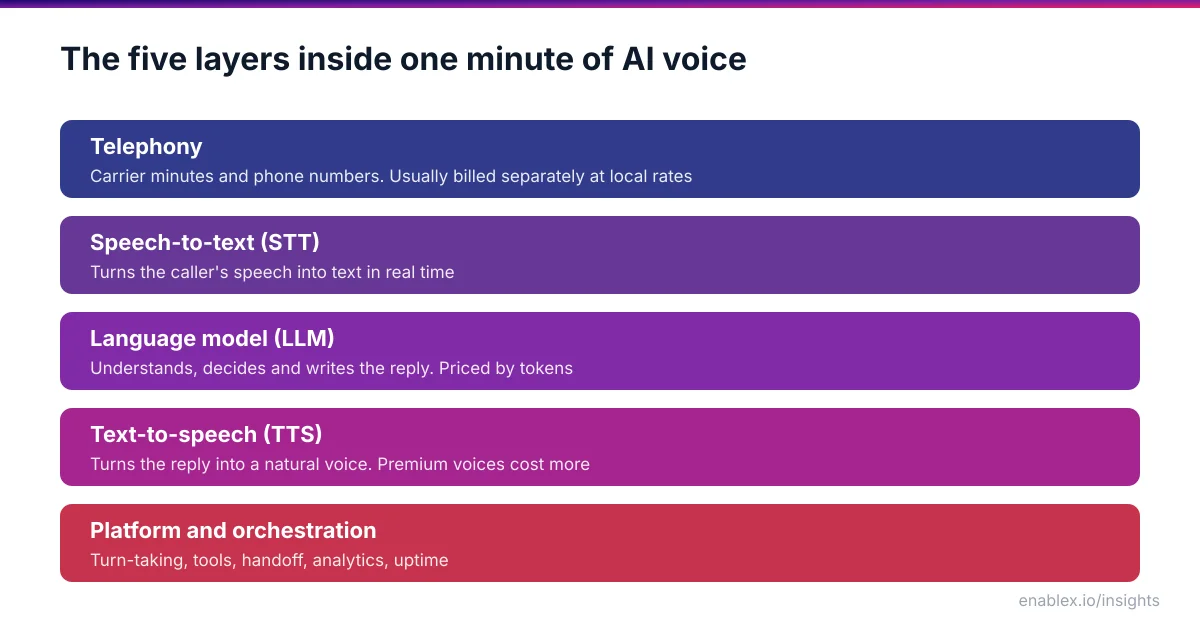
What the figure shows: The five layers inside one minute of AI voice, from top to bottom: Telephony (carrier minutes and phone numbers. Usually billed separately at local rates); Speech-to-text (STT) (turns the caller's speech into text in real time); Language model (LLM) (understands, decides and writes the reply. Priced by tokens); Text-to-speech (TTS) (turns the reply into a natural voice. Premium voices cost more); Platform and orchestration (turn-taking, tools, handoff, analytics, uptime).
Telephony
This is the cost of the phone call itself: the carrier minutes from your number to the customer's phone, plus the monthly rental of the numbers you use. It varies a lot by country, and by mobile versus landline. Most voice AI providers charge it separately. At EnableX, telephony is billed at local carrier rates.
Speech recognition
Streaming speech-to-text runs for the whole call, whether the caller is talking or not. Models tuned for specific languages or for telephone audio can cost more, but they usually pay for themselves in fewer misheard names, numbers and amounts.
The language model
The LLM is billed by tokens: the instructions, the conversation so far and the reply. Long system prompts and long calls push the cost up, because the model rereads the whole conversation on every turn. Small, fast models handle most scripted use cases well. Larger models earn their place in open-ended support or complex sales calls.
Voice synthesis
Standard voices are cheap, while premium, very natural voices and cloned brand voices cost more per character. For high-volume outbound calls, pre-recording the phrases the agent says on every call (greetings, disclosures, confirmations) cuts both cost and delay.
The platform
This is what turns four separate AI services into an agent that works on a real phone line: handling interruptions, calling your systems mid-conversation, transferring to a human, recording, reporting and staying up at peak load. It is the part buyers most often forget to price when they plan to build it themselves.
An agritech client in India moved its crop-advisory and payment-reminder calls to farmers from a vendor whose per-minute rate was about 15% lower than ours. When their finance team put the two bills side by side, they found the old vendor charged separately for call transfers and recordings. With a tighter script and speech recognition tuned for the local languages their farmers speak, average call length fell by 25% and resolved calls rose by 35%, so their cost per resolved call came out about 35% lower even at the higher rate per minute.
Which AI voice agent costs are easy to miss?
The billing increment, unanswered and voicemail calls, human handover time, recording and storage, call concurrency limits and set-up work can all add to the bill. Ask about each one before you compare quotes.
- Billing increment: some providers bill per second, others per minute or in blocks. Check how short calls and the last part of a minute are counted. EnableX Voice AI is billed per minute.
- Unanswered and voicemail calls: on outbound campaigns, a large share of dials never reach a person. Answering machine detection stops the agent from talking to voicemail and burning minutes.
- Human handoff time: when the agent transfers a call, the human agent's minutes and the transfer leg may be billed separately.
- Recording, transcripts and storage: some providers charge for each; some include them for a limited period.
- Concurrency: a low rate can come with a cap on simultaneous calls. Campaigns that need hundreds of parallel calls may need a higher plan.
- Set-up and changes: custom voices, integrations and prompt changes may be priced as projects rather than included.
How do you calculate cost per resolved call?
Multiply the average call length by the all-in rate per minute, then divide by the share of calls the agent fully resolves. Compare that figure with what the same call costs today with a human agent.
A cheaper agent that resolves fewer calls is not cheaper. Use this calculation when you compare options:
Input | What to measure |
|---|---|
Average call length | Minutes per call, from a pilot, not a demo |
All-in rate per minute | AI rate + telephony + extras |
Resolution rate | Share of calls fully handled without a human |
Cost of a human-handled call | Your current cost per call in the contact center |
Cost per resolved call = (call length x all-in rate) / resolution rate
Then compare that figure to what the same call costs today with a human agent. For collections, renewals and appointment reminders, this is usually where the business case becomes clear.
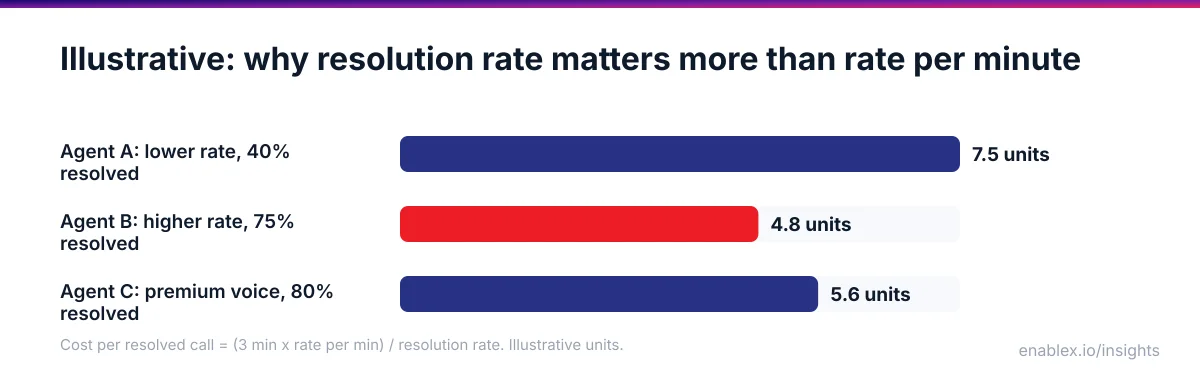
What the figure shows: Illustrative: why resolution rate matters more than rate per minute: Agent A: lower rate, 40% resolved (7.5 units); Agent B: higher rate, 75% resolved (4.8 units); Agent C: premium voice, 80% resolved (5.6 units). Cost per resolved call = (3 min x rate per min) / resolution rate. Illustrative units.
How can you keep the per-minute cost down without hurting quality?
Match the model to the job, keep prompts short, pre-record fixed phrases and keep calls focused. On outbound campaigns, answering machine detection stops the agent spending minutes on voicemail.
- Match the model to the job. Use a small, fast model for reminders and confirmations, and a larger one only where calls are open-ended.
- Keep prompts short: every extra paragraph of instructions is billed on every turn of every call.
- Pre-record what never changes: greetings, legal lines and closings can be cached audio instead of fresh synthesis.
- Shorten the call: ask one question at a time, confirm once, and end the call as soon as the job is done.
- Use answering machine detection on outbound. Leave a short recorded voicemail instead of a live AI conversation with a machine.
- Keep data in-region: processing close to the caller cuts delay and can avoid cross-border data charges.
What should you ask an AI voice agent vendor about pricing?
Ask what the per-minute rate includes, how billing is rounded, how many calls can run at once and what a transfer to a person costs. Most importantly, ask for a pilot on your own calls so you can measure resolution rate.
- What exactly is included in the per-minute rate, and what is billed separately?
- What is the billing increment?
- Which speech and language models are behind each price tier, and can I change them later?
- How many simultaneous calls does my plan allow?
- What does a transfer to a human cost?
- Can you run a pilot on my real calls so I can measure resolution rate before I commit?
How does EnableX price AI voice agents?
EnableX publishes per-minute Voice AI pricing on the website. The rate depends on the speech, language and voice models you choose, so you can trade cost against quality for each use case. Telephony is billed at local carrier rates. Every Voice AI package includes live handover to a human agent with a call summary, and you can start with the free trial wallet credit, which works across all EnableX services. EnableX handles 10M+ conversations a month for customers in 20+ countries.
See Voice AI pricing or book a 20-minute pricing walkthrough with your own call volumes.
Frequently asked questions
How much does an AI voice agent cost per minute?
It depends on the models used and on whether telephony is included. Lighter setups cost a fraction of premium ones. Always ask what the per-minute rate includes and compare what each resolved call costs, which tells you far more than the rate.
Is an AI voice agent cheaper than a human agent?
For high-volume, repeatable calls such as reminders, collections, renewals and bookings, usually yes, once you count the cost per resolved call. For complex or emotional calls, a human is often still the better choice.
Why is telephony billed separately?
Carrier costs vary widely by country and by mobile versus landline. Billing them separately at local rates keeps the AI rate the same across markets.
What drives the price of voice AI the most?
The choice of language model and voice. Large models and premium or cloned voices cost more per minute. Long prompts and long calls also add cost.
How is EnableX Voice AI billed?
EnableX bills Voice AI per minute. The rate depends on the models you choose, and telephony is billed at local carrier rates.
Founder and CEO, EnableX
Pankaj Gupta has spent 25+ years building IT and telecom businesses across Asia-Pacific and global markets. EnableX is his third company; the first two were built from zero and acquired by global companies. He also invests in B2B startups and mentors founders across the region.
Connect on LinkedIn →