WhatsApp Business API Pricing After 1 October 2026: What Changed and How to Cut Your Bill

From 1 October 2026, Meta charges for service messages on the WhatsApp Business Platform. These are the free-form replies a human agent or a chatbot sends inside the 24-hour customer service window. Each business phone number gets 1,000 free service messages a month, and every one after that's charged. Utility templates sent inside an open service window, which had been free since July 2025, are now charged too. Meta's own AI agent has been billed per token since 1 August 2026. Support-heavy businesses will see the biggest increase, and the fix is to send fewer, better messages and to use the right channel for each job.
For almost two years, replying to customers on WhatsApp was free. If a customer messaged you, you could answer as many times as you liked inside 24 hours without paying Meta anything. Many businesses built their whole support model on that.
That changed on 1 October 2026. This post explains exactly what changed, what it means for your monthly bill, and the practical steps we are taking with customers to keep costs under control.
How does WhatsApp Business API pricing work now?
Meta charges per delivered message. Messages from customers to you are free. Each message you send is charged based on two things: its category and the country code of the person receiving it.
There are five categories:
Category | What it is | When you can send it | Charged? |
|---|---|---|---|
Marketing | Offers, promotions, re-engagement | Any time (approved template) | Yes |
Utility | Order updates, payment reminders, account alerts | Any time (approved template) | Yes, now also inside the service window |
Authentication | One-time passcodes | Any time (approved template) | Yes |
Service | Free-form replies from a human agent or third-party bot | Only inside the 24-hour service window | Yes, after 1,000 free per number per month |
Meta Business Agent | Replies generated by Meta's own AI agent | Only inside the service window | Yes, per token |
On top of Meta's charge, your WhatsApp provider adds its own platform fee or margin. When you compare providers, always compare the total cost per message rather than Meta's rate alone.
What changed on 1 October 2026?
Service messages, the free-form replies inside the 24-hour window, are now charged after 1,000 free messages per business number each month. Utility templates sent inside an open window are charged again too.
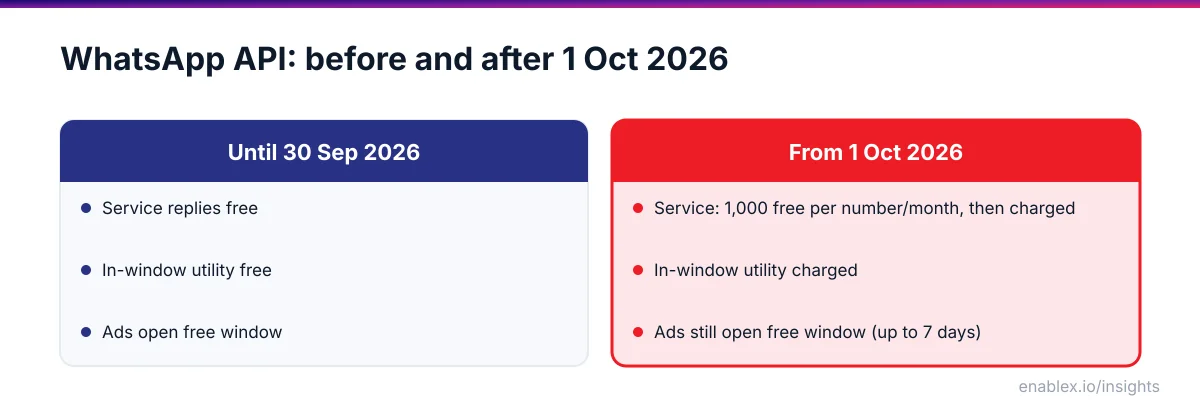
What the figure shows: WhatsApp API: before and after 1 Oct 2026: Until 30 Sep 2026 (service replies free, in-window utility free, ads open free window); From 1 Oct 2026 (service: 1,000 free per number/month, then charged, in-window utility charged, ads still open free window (up to 7 days)).
Service messages are no longer free
Free-form replies inside the 24-hour customer service window had been free since 1 November 2024. From 1 October 2026 they are charged, after a free allowance of 1,000 service messages per business phone number per month. The allowance resets each month and unused messages do not carry over.
This applies whether the reply comes from a human agent typing in an inbox or from a chatbot running on another platform.
Utility templates inside the window are charged again
Utility templates sent while a service window was open had been free since 1 July 2025. That exemption has now ended. An order confirmation sent while a customer is chatting with you now costs the same as one sent at any other time.
Meta's AI agent is billed per token
Since 1 August 2026, replies from Meta Business Agent are billed at US$2 per million input and output tokens, one global rate. Meta estimates a typical message at 20,000 to 25,000 tokens, or roughly 4 to 5 US cents per reply. Volume tiers and free allowances don't apply to these messages.
Two things that did not change
- Click-to-WhatsApp ads still open a free window. If a customer messages you from an ad and you reply within 24 hours, your messages are free for up to 7 days. The exception is Meta Business Agent replies, which are still charged.
- Volume tiers still apply to utility and authentication. The more of these you send in a market each month, the lower the rate for messages in the higher tiers.
Eligible government bodies and non-profits keep free service messages beyond the 1,000 allowance until 31 December 2027.
What does this mean for your WhatsApp bill?
Support conversations now cost money on every message after the free allowance, at the same rate as utility messages to that country. Long, chatty flows with many short messages cost the most.
Service messages are now charged at the same rate as utility or authentication messages to the same country. Rates vary widely by market, and rich markets cost far more than emerging ones. A marketing message to Germany, for example, costs about five times more than the same message to the US on Meta's current rate card.
To estimate your new support cost, work through four steps:
Step | What to calculate |
|---|---|
1 | Count the free-form replies your agents and bots sent last month, per business number |
2 | Subtract 1,000 per number |
3 | Multiply the remainder by the service rate for each customer country, plus your provider fee |
4 | Add utility templates that were sent inside open windows, since these are now charged |
The businesses hit hardest are the ones that built long, chatty support flows: a bot that sends five short messages where one would do, or agents who send "Thanks!" and "Anything else?" as separate messages. Every one of those is now a line on the invoice.
How can you cut your WhatsApp bill?
Start by auditing your message mix, then send fewer, fuller messages and move data capture into WhatsApp Flows. The eight tactics below each cut cost without making the customer experience worse.
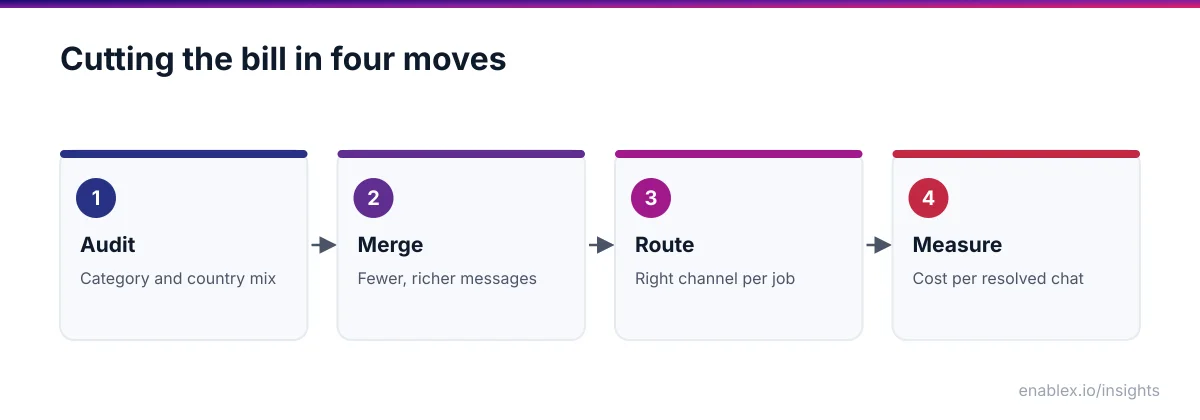
What the figure shows: Cutting the bill in four moves: 1) Audit: category and country mix; 2) Merge: fewer, richer messages; 3) Route: right channel per job; 4) Measure: cost per resolved chat.
- Audit your message mix: break last month's traffic into marketing, utility, authentication and service, by country. Most teams find one flow or one market driving most of the cost.
- Merge messages: combine short replies into one message. Use list messages and reply buttons instead of sending options one by one.
- Use WhatsApp Flows for data capture. Collect a booking, an address or a form in one interactive screen instead of ten back-and-forth questions.
- Cut the pleasantries: remove automatic "thank you" and "is there anything else?" messages that don't change the outcome.
- Spread volume across numbers wisely. The 1,000 free service messages apply per business number. If you run separate numbers for separate brands or regions, track the allowance on each.
- Use ads as an entry point. Conversations that start from a click-to-WhatsApp ad get a free window of up to 7 days. For sales-led businesses this can cover a large share of messaging.
- Pick the right channel for each job. Not every message needs WhatsApp. One-time passcodes, delivery alerts and reminders can often go by SMS or RCS at a lower cost in many countries, with WhatsApp used where a rich, two-way conversation matters.
- Measure cost per resolved conversation. Count total messaging cost against conversations that ended with the customer's issue solved. This one number tells you whether your bot is saving money or burning it.
The customers are now looking at a more optimized strategy including use of other channels wherever possible to optimize costs. Retail and other consumer businesses with high volumes are starting to feel the pinch!
Should you move customer support off WhatsApp?
For most businesses the answer is no. Customers in many markets prefer WhatsApp over any other channel, and a reply there is still far cheaper than a phone call to a contact center. What the change makes expensive is waste: long chains of short messages that never needed to be sent.
What it does change is the idea of WhatsApp as the only channel. The smart setup now is one messaging layer that picks the right channel for each message: WhatsApp for conversations, RCS for rich branded messages on Android and supported iPhones, and SMS as the universal fallback.
How does EnableX help you manage WhatsApp costs?
The EnableX Unified Messaging API sends SMS, WhatsApp and RCS through one API, with automatic fallback when a message cannot be delivered on the first channel. You set the channel order for each message type, so passcodes, reminders and conversations each go where they make the most sense.
- One API and one dashboard for SMS, WhatsApp and RCS
- Automatic fallback, so a failed WhatsApp or RCS message still reaches the customer by SMS
- Delivery reports for every message, showing which channel delivered it
- Conversational AI chatbots that keep replies short and use buttons, lists and Flows to finish tasks in fewer messages
- EnableX handles more than 10 million conversations a month for customers in 20+ countries
Send us last month's WhatsApp usage and we will show you where to cut cost (contact us). Or start a free trial and test the Unified Messaging API yourself.
Frequently asked questions
Are WhatsApp service messages free?
No. Since 1 October 2026, service messages on the WhatsApp Business Platform are charged after a free allowance of 1,000 per business phone number per month. They were free from 1 November 2024 to 30 September 2026.
What is a WhatsApp service message?
A service message is a free-form, non-template reply sent inside the 24-hour customer service window that opens when a customer messages you. It covers replies from human agents and third-party chatbots.
How much does Meta Business Agent cost?
Meta Business Agent replies have been billed at US$2 per million input and output tokens since 1 August 2026. Meta estimates this at roughly 4 to 5 US cents for a typical reply.
Do the changes affect the free WhatsApp Business app?
No. The pricing changes apply to the WhatsApp Business Platform (the API), whether used directly or through a provider. The consumer app and the free WhatsApp Business app aren't affected.
Are click-to-WhatsApp ad conversations still free?
Yes. If a customer messages you from a click-to-WhatsApp ad and you reply within 24 hours, messages in that window are free for up to 7 days. Meta Business Agent replies are still charged.
How can I reduce my WhatsApp Business API cost?
Audit your message mix by category and country, merge short replies, use interactive lists and Flows, drop non-essential messages, and route passcodes and alerts to SMS or RCS where that is cheaper.
Founder and CEO, EnableX
Pankaj Gupta has spent 25+ years building IT and telecom businesses across Asia-Pacific and global markets. EnableX is his third company; the first two were built from zero and acquired by global companies. He also invests in B2B startups and mentors founders across the region.
Connect on LinkedIn →