What Is PSTN? How It Works and Why AI Voice Agents Need It

PSTN stands for Public Switched Telephone Network, the worldwide system of carrier networks that lets any phone number call any other, on landline or mobile. Most of it now runs on IP inside, but it still depends on phone numbers and carrier interconnects. AI voice agents need it because customers answer phones: every call to or from your agent crosses the PSTN.
Your voice agent passed every demo. Then it went live on real phone calls, and it started mishearing names, talking over callers and getting answered less often than expected. The cause is often the phone call itself, not the model.
That call runs over the PSTN, the network under every phone number. Knowing how it behaves helps you tell a network problem from a model problem.
What is the PSTN?
The PSTN, or Public Switched Telephone Network, is the combined network of every telephone carrier in the world: fixed-line, mobile and long-distance operators, all interconnected. It is public because any number can reach any other number, and switched because the network sets up a path for each call between the two ends.
Three things hold it together:
- Phone numbers: every endpoint has a number in the international E.164 format, a country code followed by a national number, up to 15 digits in total.
- Signaling: carriers exchange messages to set up, route and end calls. Older networks use SS7, newer ones use SIP over IP.
- Interconnects: carriers agree to pass each other's calls and settle the charges. That is why a call from one country to a mobile in another simply works.
How does a PSTN call work?
Carriers first exchange signaling messages to find the destination and reserve a route, and only then does a voice path open for the audio. The path stays open until someone hangs up, and each carrier records the call for billing.
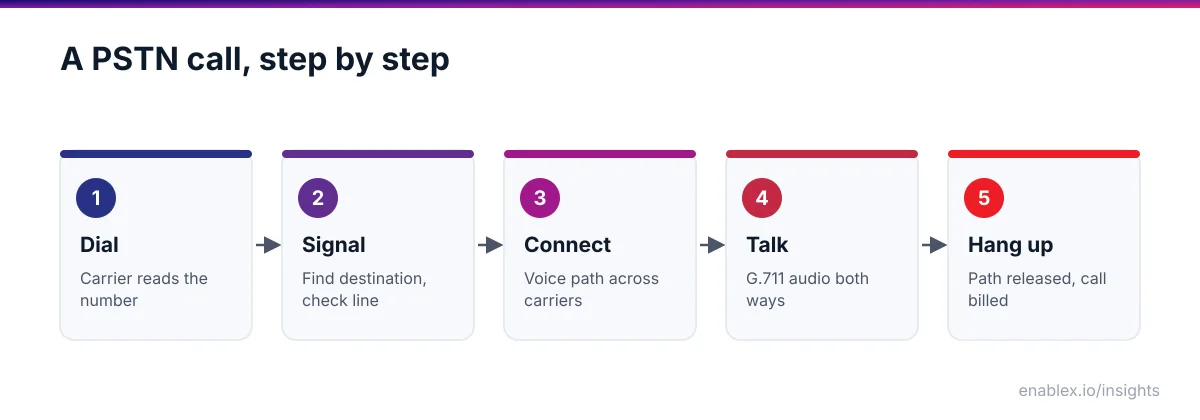
What the figure shows: the five stages of a PSTN call, from dialing to hang-up, with G.711 audio carried in both directions in the middle. The steps below explain each stage.
- The caller dials a number. Their carrier reads the country and area code and works out where the number lives.
- Signaling messages travel ahead of the call to find the destination carrier and check the line is free.
- A voice path is set up between the two carriers, often through one or more transit carriers.
- Audio flows in both directions, usually encoded with G.711, the standard telephone codec: 8,000 samples per second, covering roughly 300 to 3,400 Hz.
- When either side hangs up, the path is released and each carrier records the call for billing.
Most carrier cores now run on IP instead of copper circuits. From the outside, the rules haven't changed: numbers, carrier routing, narrowband audio and per-minute billing.
PSTN vs VoIP vs SIP: what is the difference?
They are not rivals. The PSTN is the global carrier network that connects phone numbers, VoIP is the method of carrying voice as data packets over IP, and SIP is the signaling protocol that sets up and ends VoIP calls. Each describes a different layer, and one business call usually uses all three.
Term | What it is | Where you meet it |
|---|---|---|
PSTN | The global carrier network that connects phone numbers | Any call to or from a regular phone number |
VoIP | Voice over IP: carrying voice as data packets over an IP network | Apps, softphones, business phone systems, most carrier cores |
SIP | Session Initiation Protocol: the signaling standard used to set up and end VoIP calls | SIP trunks between your platform and a carrier; IP phones; contact center systems |
SIP trunk | A connection that carries SIP calls between your systems and a carrier, which bridges them to the PSTN | How cloud platforms and AI agents reach phone numbers |
A typical business call is VoIP inside your systems, travels over a SIP trunk to a carrier, and crosses the PSTN to reach the customer's phone.
Why do AI voice agents still depend on the PSTN?
Because customers are reached on phone numbers. An agent that only works inside an app over WebRTC can't send a payment reminder, answer your support line or confirm an appointment, so any agent that talks to the public must connect to the PSTN, usually through a SIP trunk from a voice platform.
- Reach: most customers have a phone number, far fewer have your app. Payment reminders, renewals, delivery updates and appointment confirmations all go to a number.
- Inbound: customers call the number on your website, card or invoice. That number is the front door to your contact center.
- Trust: a local, recognizable caller ID gets answered. An unknown or international one often doesn't.
- Regulation: consent, do-not-call lists, calling-hour rules and caller ID rules are set per country and enforced on phone numbers.
How does an AI voice agent connect to the PSTN?
Through a voice platform that sits between the carrier and your AI. The platform connects to the carrier over a SIP trunk and streams call audio to and from the AI pipeline in real time.
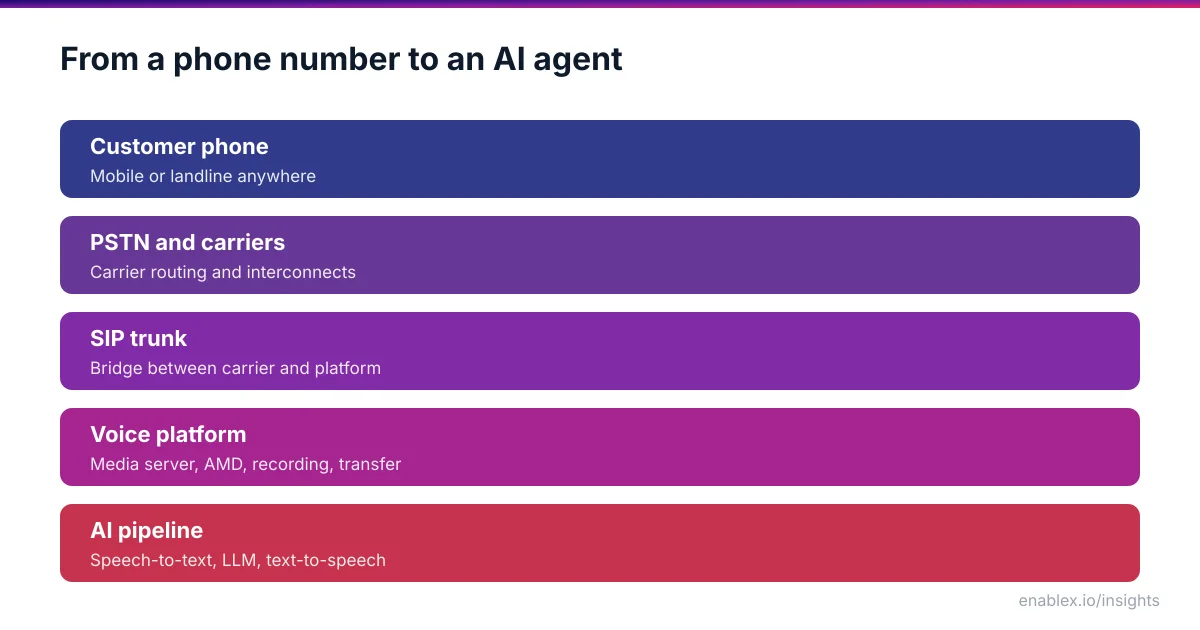
What the figure shows: From a phone number to an AI agent, from top to bottom: Customer phone (mobile or landline anywhere); PSTN and carriers (carrier routing and interconnects); SIP trunk (bridge between carrier and platform); Voice platform (media server, AMD, recording, transfer); AI pipeline (speech-to-text, LLM, text-to-speech).
A typical outbound call from an AI agent takes this path:
- Your application or campaign asks the voice platform to call a customer.
- The platform places the call from your business number over a SIP trunk to a carrier, which routes it across the PSTN to the customer's phone.
- When the customer answers, the platform checks whether it is a person or a voicemail (answering machine detection), so the agent doesn't start talking to a recording.
- Call audio is streamed in real time to the AI pipeline: speech-to-text, the language model and text-to-speech.
- The agent's spoken replies flow back the same way to the customer's phone. If the agent hands over, the call is transferred to a human agent along with a summary.
Inbound runs the same way in reverse: the customer dials your number, the carrier hands the call to the platform, and the platform connects it to the agent.
How does the PSTN affect voice AI quality?
It limits audio quality, adds delay and affects whether calls get answered. Plan for narrowband audio, network latency, noisy lines and caller ID reputation before you start tuning the model.
Narrowband audio
Standard phone audio carries only about 300 to 3,400 Hz, so sounds like "f" and "s" lose detail. That makes names, email addresses and alphanumeric codes harder to recognize. Use speech models tuned for telephone audio, not just clean studio recordings, and read key details back to the caller.
Latency
Every hop adds delay: the carrier route, any transcoding between codecs, and the distance between the phone network and your AI servers. For a natural conversation, the agent should start replying within about a second of the caller finishing. Keep media servers and AI processing near the carrier entry point, ideally in the same country or region, because you can't win that delay back in the model.
Noise and crosstalk
Callers phone in from cars, markets and shop floors. The agent has to tell a real interruption from background noise and stop speaking quickly when the caller cuts in, which engineers call barge-in.
Caller ID and answer rates
Answer rates depend heavily on the number you call from. Local numbers, consistent caller ID and a clean number reputation decide how many calls connect at all, and even the best agent can't help on a call nobody answers.
A real-world example: A lending company used a voice agent for payment reminders. It worked in testing, but on live calls it misheard names and dates, replied about 2 seconds late and went unanswered by many customers. The causes were 8 kHz phone audio, AI servers in a distant region and a single unfamiliar caller ID. The team moved to a telephone-tuned speech model with read-back of key details, placed media and AI processing in the carrier's region to bring replies to about one second, and used local numbers in each city.
What should you check before connecting an AI agent to the phone network?
Check that your numbers, audio path, speech models, consent checks and human handover are ready for real phone traffic. Gaps here show up as unanswered calls, misheard details and frustrated customers.
- Do you have local numbers in each country you call or take calls from?
- Is the audio path from carrier to AI as short as possible, with servers in-region?
- Are your speech models tuned for 8 kHz telephone audio?
- Is answering machine detection switched on for outbound calls?
- Do you have consent and do-not-call checks built into your calling lists?
- Can the agent transfer to a human, with a summary, in one step?
How does EnableX connect AI agents to the PSTN?
Most items on the checklist above depend on getting the phone network and the AI to work together. EnableX provides the phone network side and the AI side on one platform, so you don't have to stitch together a carrier, a media server and a voice AI vendor yourself. EnableX handles 10M+ conversations a month for customers in 20+ countries.
- Phone numbers and SIP trunking to reach the PSTN in 50+ countries.
- Voice API for inbound and outbound calls, IVR, call transfers and call recording.
- AI dialing with answering machine detection for outbound campaigns.
- Number masking to connect two parties, such as a customer and a delivery driver, without revealing either number.
- Voice AI agents with live handover to a human and a call summary, in English, all major Indian languages, Southeast Asian and European languages, and Arabic.
- Deployment choice: hosted, private cloud or on-premise for teams that must keep call data in-country.
- Per-minute billing for Voice AI, so cost follows the minutes your agents spend on calls.
To try it, start a free trial, take a number and connect it to a voice agent, or hear live voice agent demos.
Frequently asked questions
What does PSTN stand for?
PSTN stands for Public Switched Telephone Network. It is the global network of carrier phone systems that connects all landline and mobile phone numbers.
Is the PSTN still used today?
Yes. Most carrier networks now run on IP internally, but every call to or from a regular phone number still crosses the PSTN through carrier interconnects.
What is the difference between PSTN and VoIP?
The PSTN is the global carrier network that connects phone numbers. VoIP is a way of carrying voice as data over IP networks. Most business calls today are VoIP inside the business and reach customers over the PSTN.
What is a PSTN call?
A PSTN call is any call that reaches a regular phone number through the carrier network, as opposed to an app-to-app call that stays on the internet.
Why do AI voice agents need the PSTN?
Customers are reached on phone numbers. To call customers, or to answer calls to a business number, an AI voice agent must connect to the PSTN, usually through a SIP trunk provided by a voice platform.
Head - Engineering & AI, EnableX
Subrat Thayal is a founding member of EnableX and leads its engineering and AI. He has built the EnableX platform since the company started in 2017. He has worked alongside Pankaj Gupta for more than 20 years, and for the last few years has led the work to build AI into EnableX voice, messaging and video products.
Connect on LinkedIn →